 Add to Chrome
 Add to Firefox
 Add to Edge
GroupEnsemble: Efficient Uncertainty Estimation for DETR-based Object Detection
Mar 02, 2026
Detection Transformer (DETR) and its variants show strong performance on object detection, a key task for autonomous systems. However, a critical limitation of these models is that their confidence scores only reflect semantic uncertainty, failing to capture the equally important spatial uncertainty. This results in an incomplete assessment of the detection reliability. On the other hand, Deep Ensembles can tackle this by providing high-quality spatial uncertainty estimates. However, their immense memory consumption makes them impractical for real-world applications. A cheaper alternative, Monte Carlo (MC) Dropout, suffers from high latency due to the need of multiple forward passes during inference to estimate uncertainty. To address these limitations, we introduce GroupEnsemble, an efficient and effective uncertainty estimation method for DETR-like models. GroupEnsemble simultaneously predicts multiple individual detection sets by feeding additional diverse groups of object queries to the transformer decoder during inference. Each query group is transformed by the shared decoder in isolation and predicts a complete detection set for the same input. An attention mask is applied to the decoder to prevent inter-group query interactions, ensuring each group detects independently to achieve reliable ensemble-based uncertainty estimation. By leveraging the decoder's inherent parallelism, GroupEnsemble efficiently estimates uncertainty in a single forward pass without sequential repetition. We validated our method under autonomous driving scenes and common daily scenes using the Cityscapes and COCO datasets, respectively. The results show that a hybrid approach combining MC-Dropout and GroupEnsemble outperforms Deep Ensembles on several metrics at a fraction of the cost. The code is available at https://github.com/yutongy98/GroupEnsemble.

The Confusion is Real: GRAPHIC - A Network Science Approach to Confusion Matrices in Deep Learning
Feb 23, 2026Explainable artificial intelligence has emerged as a promising field of research to address reliability concerns in artificial intelligence. Despite significant progress in explainable artificial intelligence, few methods provide a systematic way to visualize and understand how classes are confused and how their relationships evolve as training progresses. In this work, we present GRAPHIC, an architecture-agnostic approach that analyzes neural networks on a class level. It leverages confusion matrices derived from intermediate layers using linear classifiers. We interpret these as adjacency matrices of directed graphs, allowing tools from network science to visualize and quantify learning dynamics across training epochs and intermediate layers. GRAPHIC provides insights into linear class separability, dataset issues, and architectural behavior, revealing, for example, similarities between flatfish and man and labeling ambiguities validated in a human study. In summary, by uncovering real confusions, GRAPHIC offers new perspectives on how neural networks learn. The code is available at https://github.com/Johanna-S-Froehlich/GRAPHIC.
LSA: Localized Semantic Alignment for Enhancing Temporal Consistency in Traffic Video Generation
Feb 05, 2026Controllable video generation has emerged as a versatile tool for autonomous driving, enabling realistic synthesis of traffic scenarios. However, existing methods depend on control signals at inference time to guide the generative model towards temporally consistent generation of dynamic objects, limiting their utility as scalable and generalizable data engines. In this work, we propose Localized Semantic Alignment (LSA), a simple yet effective framework for fine-tuning pre-trained video generation models. LSA enhances temporal consistency by aligning semantic features between ground-truth and generated video clips. Specifically, we compare the output of an off-the-shelf feature extraction model between the ground-truth and generated video clips localized around dynamic objects inducing a semantic feature consistency loss. We fine-tune the base model by combining this loss with the standard diffusion loss. The model fine-tuned for a single epoch with our novel loss outperforms the baselines in common video generation evaluation metrics. To further test the temporal consistency in generated videos we adapt two additional metrics from object detection task, namely mAP and mIoU. Extensive experiments on nuScenes and KITTI datasets show the effectiveness of our approach in enhancing temporal consistency in video generation without the need for external control signals during inference and any computational overheads.
Detecting and Mitigating Memorization in Diffusion Models through Anisotropy of the Log-Probability
Jan 28, 2026Diffusion-based image generative models produce high-fidelity images through iterative denoising but remain vulnerable to memorization, where they unintentionally reproduce exact copies or parts of training images. Recent memorization detection methods are primarily based on the norm of score difference as indicators of memorization. We prove that such norm-based metrics are mainly effective under the assumption of isotropic log-probability distributions, which generally holds at high or medium noise levels. In contrast, analyzing the anisotropic regime reveals that memorized samples exhibit strong angular alignment between the guidance vector and unconditional scores in the low-noise setting. Through these insights, we develop a memorization detection metric by integrating isotropic norm and anisotropic alignment. Our detection metric can be computed directly on pure noise inputs via two conditional and unconditional forward passes, eliminating the need for costly denoising steps. Detection experiments on Stable Diffusion v1.4 and v2 show that our metric outperforms existing denoising-free detection methods while being at least approximately 5x faster than the previous best approach. Finally, we demonstrate the effectiveness of our approach by utilizing a mitigation strategy that adapts memorized prompts based on our developed metric.
ProGiDiff: Prompt-Guided Diffusion-Based Medical Image Segmentation
Jan 22, 2026Widely adopted medical image segmentation methods, although efficient, are primarily deterministic and remain poorly amenable to natural language prompts. Thus, they lack the capability to estimate multiple proposals, human interaction, and cross-modality adaptation. Recently, text-to-image diffusion models have shown potential to bridge the gap. However, training them from scratch requires a large dataset-a limitation for medical image segmentation. Furthermore, they are often limited to binary segmentation and cannot be conditioned on a natural language prompt. To this end, we propose a novel framework called ProGiDiff that leverages existing image generation models for medical image segmentation purposes. Specifically, we propose a ControlNet-style conditioning mechanism with a custom encoder, suitable for image conditioning, to steer a pre-trained diffusion model to output segmentation masks. It naturally extends to a multi-class setting simply by prompting the target organ. Our experiment on organ segmentation from CT images demonstrates strong performance compared to previous methods and could greatly benefit from an expert-in-the-loop setting to leverage multiple proposals. Importantly, we demonstrate that the learned conditioning mechanism can be easily transferred through low-rank, few-shot adaptation to segment MR images.
Visual Autoregressive Modelling for Monocular Depth Estimation
Dec 27, 2025We propose a monocular depth estimation method based on visual autoregressive (VAR) priors, offering an alternative to diffusion-based approaches. Our method adapts a large-scale text-to-image VAR model and introduces a scale-wise conditional upsampling mechanism with classifier-free guidance. Our approach performs inference in ten fixed autoregressive stages, requiring only 74K synthetic samples for fine-tuning, and achieves competitive results. We report state-of-the-art performance in indoor benchmarks under constrained training conditions, and strong performance when applied to outdoor datasets. This work establishes autoregressive priors as a complementary family of geometry-aware generative models for depth estimation, highlighting advantages in data scalability, and adaptability to 3D vision tasks. Code available at "https://github.com/AmirMaEl/VAR-Depth".
Uncertainty-Aware Likelihood Ratio Estimation for Pixel-Wise Out-of-Distribution Detection
Aug 01, 2025Semantic segmentation models trained on known object classes often fail in real-world autonomous driving scenarios by confidently misclassifying unknown objects. While pixel-wise out-of-distribution detection can identify unknown objects, existing methods struggle in complex scenes where rare object classes are often confused with truly unknown objects. We introduce an uncertainty-aware likelihood ratio estimation method that addresses these limitations. Our approach uses an evidential classifier within a likelihood ratio test to distinguish between known and unknown pixel features from a semantic segmentation model, while explicitly accounting for uncertainty. Instead of producing point estimates, our method outputs probability distributions that capture uncertainty from both rare training examples and imperfect synthetic outliers. We show that by incorporating uncertainty in this way, outlier exposure can be leveraged more effectively. Evaluated on five standard benchmark datasets, our method achieves the lowest average false positive rate (2.5%) among state-of-the-art while maintaining high average precision (90.91%) and incurring only negligible computational overhead. Code is available at https://github.com/glasbruch/ULRE.
Revisiting Gradient-based Uncertainty for Monocular Depth Estimation
Feb 09, 2025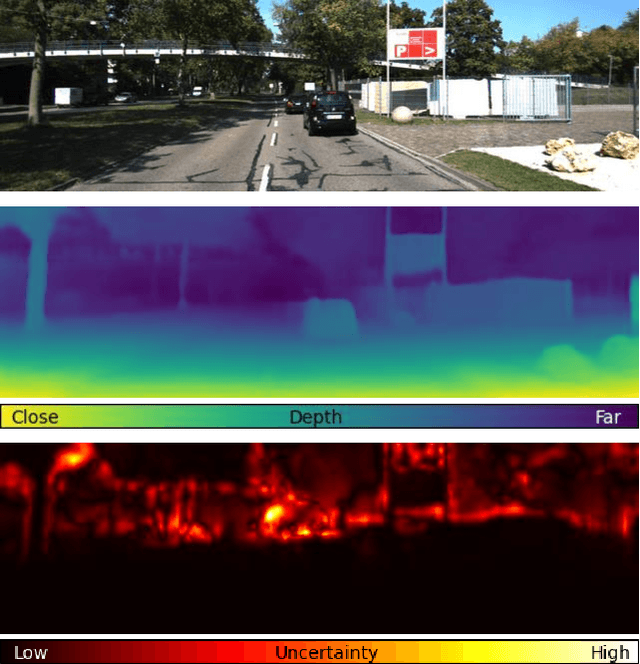
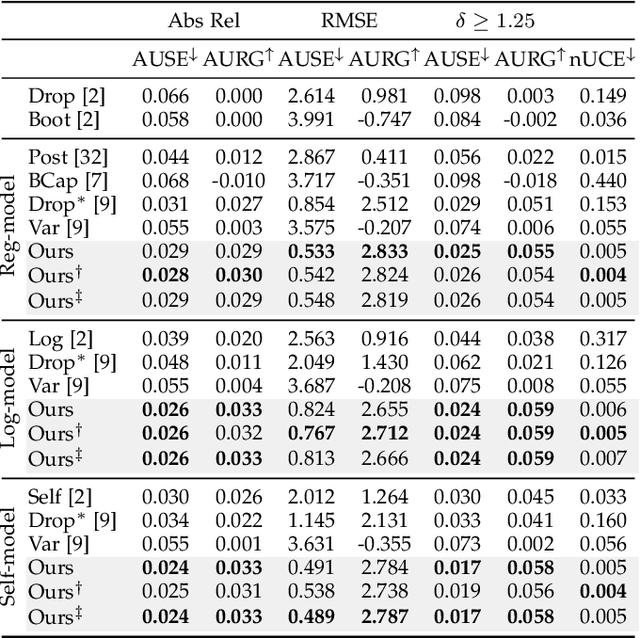
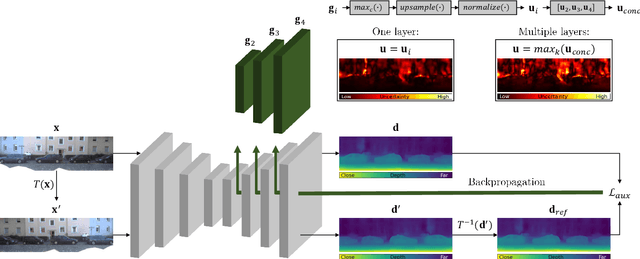
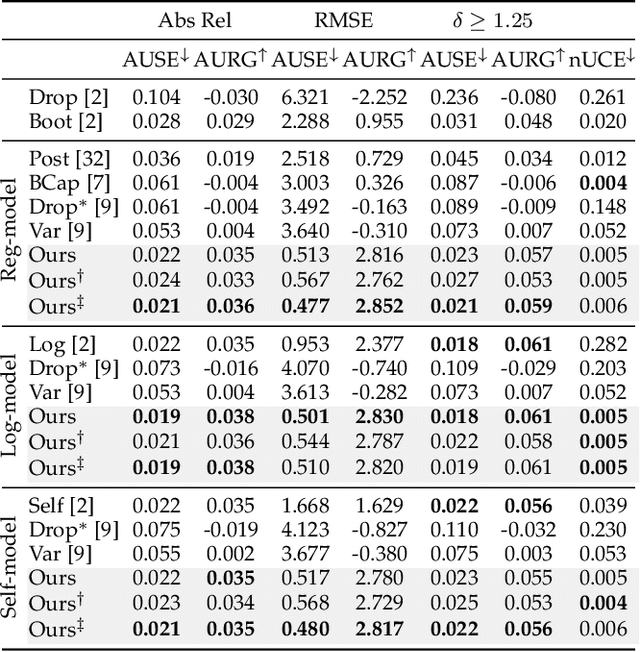
Monocular depth estimation, similar to other image-based tasks, is prone to erroneous predictions due to ambiguities in the image, for example, caused by dynamic objects or shadows. For this reason, pixel-wise uncertainty assessment is required for safety-critical applications to highlight the areas where the prediction is unreliable. We address this in a post hoc manner and introduce gradient-based uncertainty estimation for already trained depth estimation models. To extract gradients without depending on the ground truth depth, we introduce an auxiliary loss function based on the consistency of the predicted depth and a reference depth. The reference depth, which acts as pseudo ground truth, is in fact generated using a simple image or feature augmentation, making our approach simple and effective. To obtain the final uncertainty score, the derivatives w.r.t. the feature maps from single or multiple layers are calculated using back-propagation. We demonstrate that our gradient-based approach is effective in determining the uncertainty without re-training using the two standard depth estimation benchmarks KITTI and NYU. In particular, for models trained with monocular sequences and therefore most prone to uncertainty, our method outperforms related approaches. In addition, we publicly provide our code and models: https://github.com/jhornauer/GrUMoDepth
Diffusion Model Guided Sampling with Pixel-Wise Aleatoric Uncertainty Estimation
Nov 29, 2024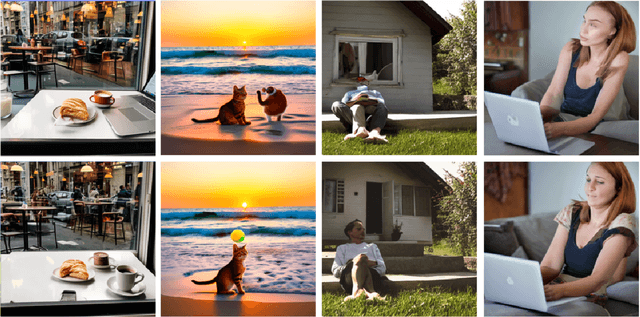
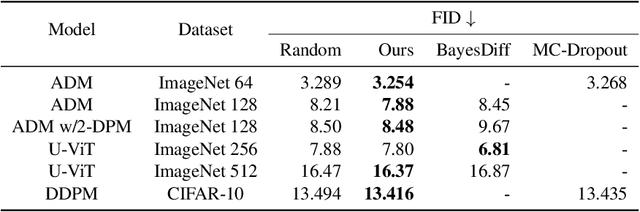

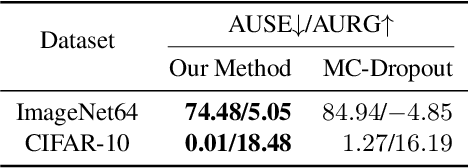
Despite the remarkable progress in generative modelling, current diffusion models lack a quantitative approach to assess image quality. To address this limitation, we propose to estimate the pixel-wise aleatoric uncertainty during the sampling phase of diffusion models and utilise the uncertainty to improve the sample generation quality. The uncertainty is computed as the variance of the denoising scores with a perturbation scheme that is specifically designed for diffusion models. We then show that the aleatoric uncertainty estimates are related to the second-order derivative of the diffusion noise distribution. We evaluate our uncertainty estimation algorithm and the uncertainty-guided sampling on the ImageNet and CIFAR-10 datasets. In our comparisons with the related work, we demonstrate promising results in filtering out low quality samples. Furthermore, we show that our guided approach leads to better sample generation in terms of FID scores.
ItTakesTwo: Leveraging Peer Representations for Semi-supervised LiDAR Semantic Segmentation
Jul 09, 2024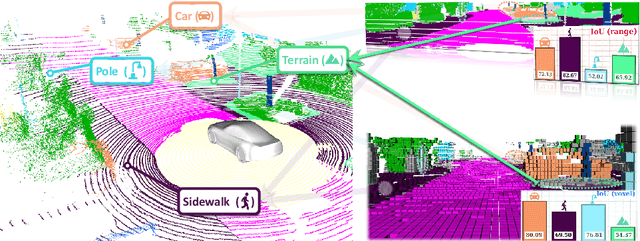
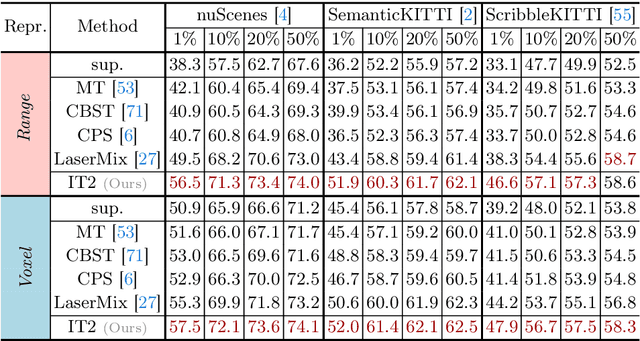
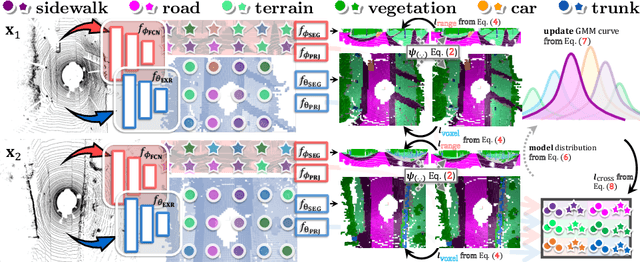
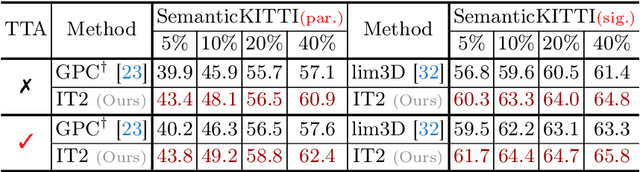
The costly and time-consuming annotation process to produce large training sets for modelling semantic LiDAR segmentation methods has motivated the development of semi-supervised learning (SSL) methods. However, such SSL approaches often concentrate on employing consistency learning only for individual LiDAR representations. This narrow focus results in limited perturbations that generally fail to enable effective consistency learning. Additionally, these SSL approaches employ contrastive learning based on the sampling from a limited set of positive and negative embedding samples. This paper introduces a novel semi-supervised LiDAR semantic segmentation framework called ItTakesTwo (IT2). IT2 is designed to ensure consistent predictions from peer LiDAR representations, thereby improving the perturbation effectiveness in consistency learning. Furthermore, our contrastive learning employs informative samples drawn from a distribution of positive and negative embeddings learned from the entire training set. Results on public benchmarks show that our approach achieves remarkable improvements over the previous state-of-the-art (SOTA) methods in the field. The code is available at: https://github.com/yyliu01/IT2.